Braking
Since braking is not really intuitive and need not be learned by painful experiment, here are some basic principles and hints for survival. Even though most of what I am about to say is a direct result of simple math, since we are in a litigious society I am obligated to say up front that these are my opinions and I take no responsibility for errors or disastrous results from their application or misapplication.
To start, let's talk about braking in a straight line on level clean pavement, presuming you have brakes that are as strong as you could wish.
As everyone has noticed, there is a weight shift forward onto the front wheel when braking. Since the amount of braking force one can put on a wheel is directly proportional to the amount of weight on it, the implication for the rider is that he must be aware of how much force he can or should put on the front or rear brake respectively. Best braking practice would be to split the braking force between brakes in the same proportion as the weight on each wheel, allowing the same factor of safety in traction at each wheel for additional demands like leaning into turns or bad traction conditions. For the average rider on a stock bike, that would mean starting at very light braking with 40% on the front wheel and 60% on the rear, then adding proportionally more braking force to the front as braking force (and weight on the front wheel) increased. As braking became severe he would actually ease off on the rear brake until, at maximum deceleration, all the braking force would be on the front wheel with no weight on the rear wheel. Here is a graphic representation of these proportions.
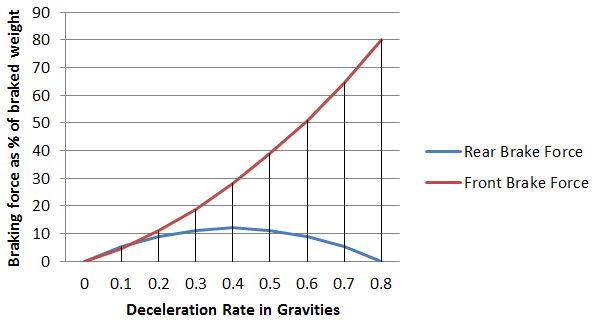
Braking severity is measured here in the deceleration rate in gravities, or g. One gravity is the deceleration rate of a rock thrown straight up, its speed decreasing by 32 feet/second each second. It is useful to describe deceleration in gravities because describing the implications of braking are simpler. For instance, to decelerate the bike and rider at one g, a force equal to their total weight would be required. To decelerate at two g, a force twice the weight, etc.
The glaring conclusion from the graph is that one needs a strong front brake. If one had a strong front brake that never failed he would never need a rear brake stronger than 15% of the front one.
Under light braking the weight shift is slight so the rider can use either brake safely without worrying about losing traction on the road. Other considerations than traction might prevail. For instance, on mountain downhills I prefer using more rear brake because the heat from prolonged rim braking has overheated tires enough to increase pressure and blow the tire off the rim. If a tire is to blow I prefer the rear one because I have better control on a quick stop balancing on the front wheel while taking weight off of the rear.
At maximum braking one might be concerned about pitching over the handlebars. The deceleration rate for pitching is determined by the relative position of the center of gravity of the bike/rider combo and the front tire contact with the ground. Draw a line between those two points and the cosine of the angle between that line and the ground is the pitchover limit in gravities. For the average rider on a standard bike that is about 0.8g. Since the book value for coefficient of friction between the tire and road on good pavement is .8, it is a tossup whether one would skid the wheel or pitch over the handlebars. If one is concerned about pitchover one would not put heavy loads high and to the front of the bike. I cringe every time I see a child riding in a handlebar seat, and on the other side of the issue it is obvious one could not pitch a tandem. You would skid the front wheel first.
Stopping Distances: (insert a table)
OK, so what if you don't have two brakes. What are the implications?
Rear brake only: You will never pitch, but hard braking takes weight off the wheel you are using for braking, limiting you to about 0.3g when the wheel skids out, less than half what you could get with front brake only. Think about buying a front brake while you try to steer around the problem instead of braking.
Front brake only: Though you can get maximum deceleration with just the front brake, pitchover is a concern. It is difficult to find the limit in a panic situation without exceeding it. If you had a rear brake, you could put very light braking on the rear and then increase force on the front until the rear skidded, warning where you were close to the limit. Without the rear brake, good luck with the guessing.
No brake: In ancient times this was the norm. There was no brake, and also no freewheel, like bikes still are in track racing. One put backpressure on the cranks to slow down, or locked one's legs to skid the rear wheel. This was not a problem since there was no traffic. My friend Harold Ade who rode in the 1932 Olympics and had a bike shop in Chicago back then told of a 40 mile race from Elgin to Chicago that only had one stop sign. Now times are different. At first thought one might think that knowing how to skid or backpedal would be the equivalent of having a rear brake, but that is not the case. If you choose to skid, sliding friction is weaker than rolling friction so you will stop faster with a rear brake than by scrubbing off tire tread on the pavement. If you back pedal to maintain traction, no matter how you try you cannot put substantial even back force around the whole pedal stroke. I do understand the connection and romance of riding the simple bike. My favorite was a beautifully built CCM pursuit bike Pat Murphy rode in the 1932 Olympics. However, even that bike had a brake. I also understand the macho culture since I was once in it, but now at 72 I view going without brakes as the height of irresponsibility. I pray that the traffic dodging machos will have good luck with their riding and our safety and live long enough to get smart.
Have brakes on both wheels: Redundancy is good. There I was years ago riding my track bike down a hill as fast as I could spin my feet, nearing the curve at the bottom. I was proud that I had graduated from macho to semi-macho mode and put on a front brake, but was surprised when the cable broke. There was no way to make the turn and the only padding I saw was a bush in front of the building at the bottom of the hill, so I locked a leg on the backstroke, vaulting over on my back into the bush, praying that it was not hiding a fire hydrant or utility box. Next day, feeling lucky though very scratched up, I was installing a new front brake cable and rear brake.
Now to the less than ideal conditions;
Weak Brakes: Historically, bicycle brakes have been pathetic. In the seventies, when the Consumer Product Safety Commission put out rules, the braking power required was not powerful enough for someone my size to skid the wheel on ice. Double your weight and you will need double the braking power for the same deceleration rate. Equipment has gotten better, but if you can't skid the rear wheel with the rear brake alone on good pavement your rear brake is inadequate. Similarly, if you apply a very small braking force to the rear wheel, then can't skid the rear wheel after gradually increasing braking force to the front, your front brake is inadequate.
All this presumes that you know which lever operates which brake. Look and test when first riding any bike, as there is not consistency here. I prefer to have the front brake on the right lever, because I also ride a mororcycle and that is where it is on the motorcycle. I want to have consistently correct automatic responses in an emergency for whichever machine I am on. I have heard it said that one should have the front brake on the left lever because that is the weaker hand side and one could avoid pitchover with the weaker hand on the front brake. That makes no sense. You should be able to operate each brake to the limit of its power. If you limit the power of the front brake to avoid pitchover when it is dry, you will not have enough braking power when the rims are wet. There are only two choices here - having powerful brakes and knowing how to use them... or having accidents.
Bad Traction: Of course, the limit on one's deceleration rate in gravities is equal to the coefficient of friction between the tire and the road. The book value for coefficient of friction between rubber and concrete is .8 which is about the same as the deceleration rate for pitchover, so maximum deceleration would be .8g with all the braking force on the front brake. On ice, where the book value for coefficient of friction is .1, the deceleration limit from traction would be .1g, using only about 1/16 the available power of the brakes, about evenly applied because there would be little weight shift at that deceleration rate.
Turns: When leaning into a turn some traction is used up in holding the bike into the turn so there is less left for braking. Lean far enough and you cannot brake at all without sliding out. The limit for lean without braking is easily calculated. It is when the tangent of your lean angle equals the coefficient of friction between your tire and the road. For the .8 good pavement coefficient, that is a lean angle of 38.7 degrees.
Wet: Wet conditions not only decrease friction between the tire and the road, but effect the function of the brakes as well. Rim brakes can have erratic behavior, starting about a third as good on wet rims as dry, then getting grippier as you use the brake and the rims dry out and heat up. Be cautious. These conditions are not easy to figure out.
Uneven Conditions: This is the worst. There are some things you just cannot avoid, so must allow a factor of safety. The ridiculously unexpected is my brother on his motorcycle following a pig truck on an entrance ramp when the truck hit a bump, dumping pig poop right in front of him. More boringly, I have been down twice on curves, skidding out on invisible diesel spills. And of course, there is always that little patch of gravel or sand on an otherwise clean turn, or the wet leaf, or the sewer cover.
Equipment: I have only one absolute nono, at least for me, coaster brakes. Of course you should also have a front brake. Beware of the coaster unless you are extremely light or all you do is ride slowly in your bathing suit down the beach boardwalk. I have never seen a coaster brake that I cannot melt and sieze up on a long downhill. I have been happy to see disk brakes become popular, as they have better and more uniform behavior when wet, and are free of the tire heatup and blowoff problem. Just test your brakes to see if they are powerful enough and do not ignore maintenance and adjustment.